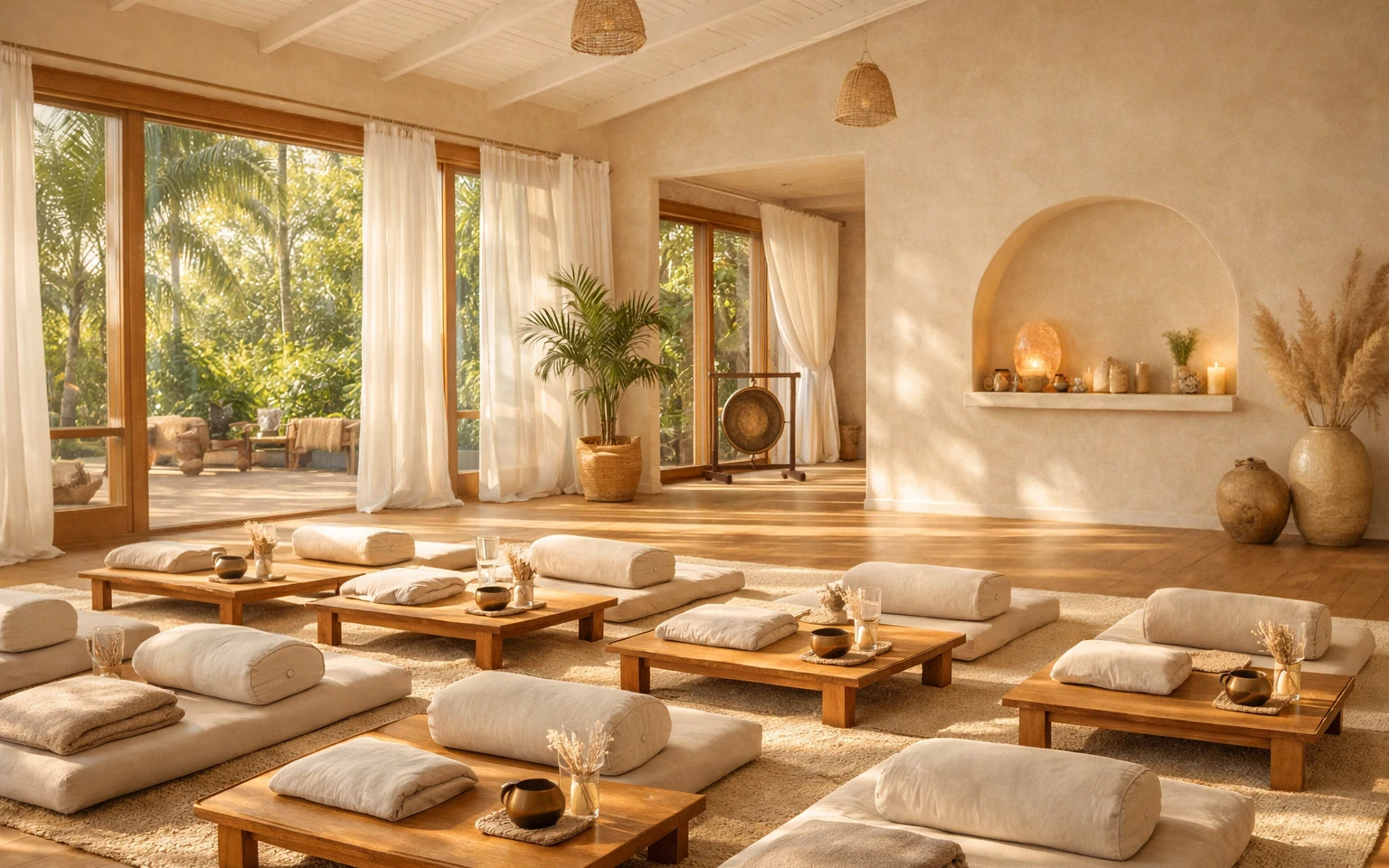
The Nervous System Room
In Nosara, practice moves beyond exercise. Within the Nervous System Room, yoga becomes a quiet exploration of regulation, awareness, and refinement, where subtle shifts in breath, posture, and attention reshape the experience of the body itself.
There are many beautiful places to practice yoga in the world.
Open-air studios overlooking the ocean. Jungle shalas where warm air moves slowly through the trees. Rooms filled with music and movement.
These environments can be inspiring. They can energize the body and create memorable experiences. Yet the deeper work of practice often asks for something different.
It asks for quiet.
In Nosara, the Nervous System Room was created with that intention. Not as a studio designed for performance or intensity, but as a space where the nervous system itself becomes the focus of the practice.
The body carries the imprint of the life we live. Long days of concentration, constant stimulation, travel, responsibility, decision-making. Over time the nervous system adapts to that pace. Muscles tighten, breath becomes shallow, attention fragments. The body learns to remain slightly alert, even when the moment does not require it.
Most people experience this as tension. Tight hips. A stiff neck. A restless mind.
But beneath these sensations is something more fundamental: a nervous system that has become accustomed to operating at a higher level of activation.
Yoga, when approached with patience, can begin to shift that pattern.
In the Nervous System Room, the pace of practice slows. Movements are not rushed. Postures are explored gradually, often with pauses that allow the body to register what it is experiencing. Breath is given space to deepen naturally rather than being forced into rhythm.
These small changes may appear subtle from the outside. Yet internally they create a different environment for the body.
When the nervous system feels safe, muscles begin to soften. Breath becomes quieter and more expansive. Attention settles into sensation rather than drifting through thought. What initially feels like stillness often reveals a surprising amount of internal activity, micro-adjustments in posture, subtle releases of tension, shifts in balance that were previously unnoticed.
This is where the practice becomes interesting.
Many people come to yoga believing they need to stretch more, strengthen more, or push their limits further. Sometimes that approach can be useful. But very often the most meaningful change happens when the body is given permission to slow down.
In that slower space, awareness begins to sharpen.
The relationship between breath and posture becomes clearer. The body learns that it does not need to brace against gravity in the way it once did. Movements become less mechanical and more responsive. Instead of forcing flexibility, the body begins to reorganize itself around ease.
This kind of practice does not always look dramatic. There are no competitions for depth of posture or intensity of effort. Yet the effects can be profound.
People often notice that their breathing changes throughout the day. That sitting becomes easier. That the tension they once carried in their shoulders or lower back begins to diminish without aggressive stretching. Perhaps most importantly, they begin to experience moments of quiet inside the body, moments where effort softens and attention becomes steady.
Nosara offers a natural setting for this kind of work. The rhythm of the ocean, the warmth of the air, and the slower pace of life create conditions that support reflection and presence. Yet the true environment of the practice is not the landscape outside.
It is the landscape of the nervous system itself.
The Nervous System Room exists as a place where that landscape can be explored carefully. Through private sessions and small, attentive work, the practice becomes less about performing yoga and more about experiencing it from within.
For some people, this is the first time yoga begins to feel truly personal.
Not a sequence to memorize.
Not a class to keep up with.
But an experience of the body learning how to settle, reorganize, and move with greater intelligence.
In this way, practice becomes something quieter and more refined.
A gradual return to balance.
A deeper relationship with breath.
And a reminder that the most meaningful shifts often happen in the moments where nothing dramatic appears to be happening at all.
Private Access Journal
Private retreat experiences and small gatherings are occasionally offered in Nosara, Costa Rica for those interested in exploring this work more deeply.
If you would like to be informed when these opportunities become available, you may join the private access journal below.
Updates are shared quietly and infrequently.